10k Gold vs 14k Gold: Which Should You Choose?
A practical head-to-head comparison of 10k Gold and 14k Gold, covering quick verdict, key differences, category winners, buyer fit, and FAQ.
10k Gold vs 14k Gold: Which Should You Choose?
Head-to-head comparison
Overall winner: 14k gold for its ideal balance of rich colour, durability, and value.
For most people buying fine jewellery, 14k gold is the superior choice. It offers the classic, warm yellow hue that defines gold while being strong enough for frequent wear. However, if your top priority is maximum durability for an everyday piece or you're working with a tighter budget, 10k gold is an incredibly practical and sensible alternative.
This comparison is based on a detailed analysis of the material properties, industry standards, and common buyer feedback for both 10k and 14k gold alloys. We've assessed them from the perspective of a maker and a wearer to help you feel confident in your choice.
Choosing between 10k and 14k gold can feel confusing. Both are "real" gold, but the numbers refer to their purity, which directly impacts their colour, strength, and price. While 14k gold is often seen as the industry standard for fine jewellery in the UK and beyond, its higher price and softer nature mean it isn't automatically the best option for every person or every project. This guide breaks down the practical differences to help you find the perfect fit for your lifestyle, budget, and creative vision.
Option A
10k Gold
- Best for ultimate durability
- The most affordable solid gold
- Paler, more subtle colour
Option B
14k Gold
- Best for fine jewellery
- Rich, classic gold colour
- Balanced durability and purity
Head-to-Head Scorecard
Measurement
Durability for Daily Wear
When crafting or buying a piece of jewellery intended for everyday life, like a wedding band or a simple chain, durability is paramount. Gold itself is a very soft metal. To make it strong enough to withstand daily bumps and scrapes, it's mixed, or 'alloyed', with other, harder metals like copper, silver, zinc, and nickel.
The karat number tells you the ratio of pure gold to these other metals. 10k gold is made of 10 parts pure gold and 14 parts alloy metals. 14k gold is 14 parts pure gold and 10 parts alloy metals. Because 10k gold has a higher percentage of these stronger alloy metals (58.3% alloys vs. 41.7% in 14k gold), it is significantly harder and more resistant to scratching and denting. This makes it an exceptionally practical choice for rings worn constantly, bracelets that might knock against desks, or jewellery for people with active lifestyles or hands-on jobs.
While 14k gold is certainly durable enough for most fine jewellery and is a popular choice for engagement rings for this reason, it is undeniably softer than 10k. It will show fine scratches and wear more quickly over time. For sheer toughness and resilience against the rigours of daily life, 10k gold has the clear advantage.
Measurement
Gold Purity and Colour
The defining characteristic of gold is its beautiful, warm, yellow lustre. The richness of this colour is directly tied to the purity of the metal. Pure, 24k gold has a deep, almost orange-yellow hue, but as we've noted, it's far too soft for practical jewellery.
This is where the trade-off becomes clear. 14k gold, at 58.3% pure gold, retains much more of that classic, saturated yellow colour that people associate with fine gold jewellery. It strikes a beautiful visual balance, looking unmistakably rich and luxurious.
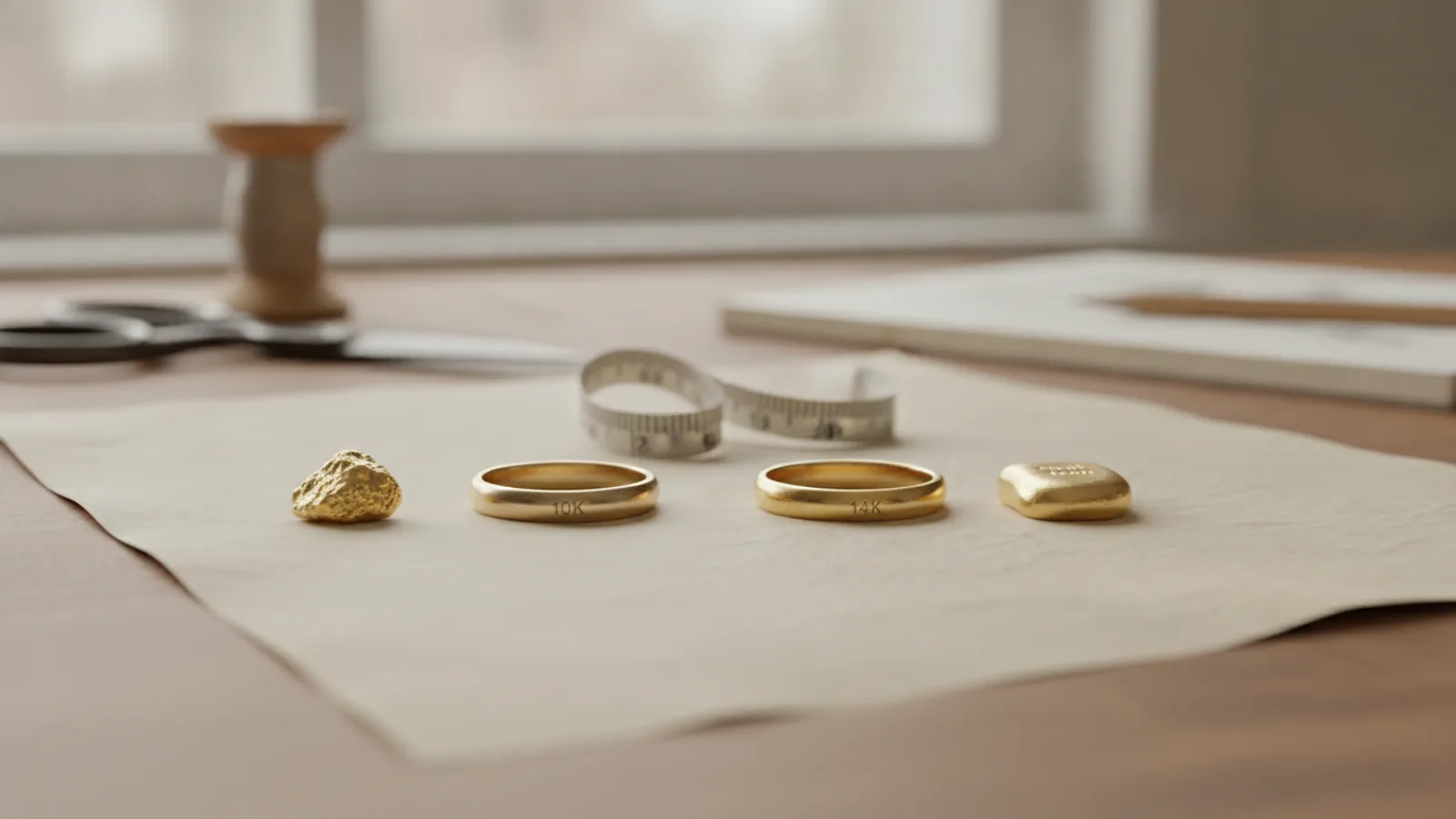
In contrast, 10k gold, with only 41.7% pure gold, has a noticeably paler and more subtle yellow tone. The higher concentration of other metals, which are often silver-toned (like zinc, palladium, or nickel), dilutes the deep yellow of the gold. When placed side-by-side, the difference is apparent. The 14k piece will look warmer and more "golden." While some people may prefer the understated hue of 10k gold, for those seeking that quintessential rich gold look for a special piece, 14k is the undisputed winner in appearance.
Measurement
Ease of Use for Makers
From a craftsperson's perspective, the workability of a material is a key consideration. Both 10k and 14k gold are excellent materials for jewellery making, but they handle slightly differently due to their composition. The hardness of 10k gold, while a benefit for durability, can make it slightly more challenging for certain delicate tasks. It requires more force to bend and shape, and it can be a bit more brittle than 14k. Polishing 10k gold to a high shine can also take more effort due to its resistance to abrasion.
14k gold, being slightly softer and more malleable, is often considered more forgiving to work with. It's easier to form, set stones in, and finish. Its composition makes it flow nicely when soldering and it achieves a brilliant polish with relative ease. This balance of strength and workability is a major reason why it's a favourite among professional jewellers and hobbyists alike. While a skilled maker can create beautiful work with either material, 14k gold often provides a smoother, more user-friendly experience during the crafting process.
Measurement
Affordability and Value
The price of a piece of gold jewellery is primarily determined by its gold content. Since gold is a precious metal traded on global markets, the more pure gold in the alloy, the more expensive the final piece will be. This makes the comparison on affordability very straightforward.
With only 41.7% pure gold, 10k gold is significantly less expensive than 14k gold, which contains 58.3% pure gold. For an identical piece, you can expect the 10k version to be 20-40% cheaper than its 14k counterpart. This price difference makes solid gold jewellery accessible to a much wider audience. It allows you to get the look and longevity of real gold without the higher price tag, making it a fantastic choice for gifts, fashion jewellery, or for makers who want to manage their material costs.
However, "value" can be interpreted in two ways. While 10k gold wins on upfront cost, 14k gold holds more intrinsic value. Because it contains more of the precious metal, its scrap or resale value will always be higher. If you view your jewellery as a long-term store of value as well as a beautiful object, 14k offers a better investment. But for the practical purpose of buying a beautiful, durable piece for the lowest price, 10k is the clear winner.
Measurement
Buyer Confidence and Hypoallergenic Qualities
For many wearers, especially those with sensitive skin, the composition of jewellery is a critical factor. Allergic reactions to gold are extremely rare; the true culprits are usually the other metals in the alloy, most commonly nickel. Since 10k gold contains a higher percentage of alloy metals (58.3%), the probability of it containing a higher concentration of potential irritants like nickel is greater.
14k gold, with its lower alloy content (41.7%), is generally considered a safer bet for sensitive skin. The higher purity means there's simply less room for the metals that tend to cause contact dermatitis. Most people can wear 14k gold without any issues, which is another reason it has become the standard for pieces that are worn constantly, like engagement rings and wedding bands. If you're buying a gift and are unsure of the recipient's sensitivities, or if you have had reactions to metal jewellery in the past, choosing 14k gold provides greater peace of mind.
It's important to note that many modern jewellers in the UK and EU use nickel-free alloys for both 10k and 14k gold, often substituting it with palladium. However, the risk is inherently lower with 14k, making it the more confident choice for avoiding skin irritation.
Choose 10k Gold If...
- Durability is your number one priority. You have an active lifestyle, work with your hands, or are buying a piece (like a ring) that will endure constant wear.
- You are on a strict budget. 10k gold offers the experience and longevity of solid gold at the most accessible price point.
- You prefer a subtler, paler gold colour. You appreciate a less saturated yellow hue that is more understated than higher-karat gold.
- You're buying for a child or teenager. Its toughness and lower cost make it a practical and worry-free choice for a first piece of fine jewellery.
Choose 14k Gold If...
- You want the classic, rich gold appearance. The deep, warm colour of 14k gold is what most people picture when they think of fine jewellery.
- You are buying a significant piece. For an engagement ring, wedding band, or milestone gift, 14k is the industry standard that balances beauty and value.
- You have sensitive skin. The lower alloy content makes it a more hypoallergenic and reliable choice for comfortable, everyday wear.
- You value a balance of qualities. You want a piece that is durable but also has a high gold content, beautiful colour, and solid intrinsic value.
Choose 10k Gold If
- You want the stronger default fit after checking the current evidence.
- You care about broader usefulness across the main comparison criteria.
- You prefer the option with clearer decision support for most readers.
Choose 14k Gold If
- Your situation matches 14k Gold's narrower strength more closely.
- You prefer a simpler starting point with fewer tradeoffs to manage.
- You have verified the current details and they fit your specific priority.
Final Verdict: 10k Gold vs 14k Gold
After a detailed comparison of their material properties and practical applications, 14k gold emerges as the overall winner. It represents the sweet spot for fine jewellery, offering the rich, warm colour that makes gold so desirable, a high intrinsic value, and excellent durability that's more than sufficient for most people's daily lives. Its more hypoallergenic nature also provides crucial peace of mind, making it the ideal choice for important pieces like engagement and wedding rings.
However, this doesn't diminish the incredible utility of 10k gold. It is the undisputed champion of durability and affordability. If you need a piece of jewellery that can truly withstand anything, or if your budget is the primary driver of your decision, 10k gold is not just a compromise—it's the smartest choice you can make. It delivers the prestige and longevity of solid gold in a practical, hard-wearing, and cost-effective package.
Ultimately, your choice depends on your priorities. For timeless beauty and balanced performance, choose 14k gold. For maximum toughness and value, choose 10k gold.
10k Gold vs 14k Gold: Which Should You Choose? FAQ
What does the 'k' in 10k and 14k gold mean?
The 'k' stands for karat, which is a unit of measurement for the purity of gold. A karat represents 1/24th part of the whole. Pure gold is 24k. Therefore, 10k gold is 10 parts pure gold and 14 parts other metals, making it 41.7% pure gold. 14k gold is 14 parts pure gold and 10 parts other metals, making it 58.3% pure gold.
Is 10k gold "real" gold?
Yes, absolutely. 10k gold is real gold. To be legally sold as "gold" jewellery in the UK, an item must have a minimum purity of 9 karats. At 10 karats (41.7% gold), it is well above this threshold and is considered authentic, solid gold jewellery.
Will 10k gold tarnish or turn my skin green?
Because it has a higher percentage of alloy metals like copper and silver, 10k gold is more likely to tarnish over time than 14k gold. In rare cases, particularly with high body acidity or exposure to certain chemicals, the copper content can cause a temporary green discolouration on the skin. However, this is uncommon with quality-made pieces and can be easily cleaned off.
Which is better for engagement rings, 10k or 14k gold?
14k gold is the most popular and recommended choice for engagement rings. Its superior colour, higher value, and hypoallergenic properties make it the standard for such a significant piece of jewellery. However, for those with a very active lifestyle or a tight budget, a 10k gold ring is a very durable and practical alternative that will last a lifetime.
Can you tell the difference between 10k and 14k gold just by looking?
When you look at them side-by-side, yes, the difference is noticeable. 14k gold has a visibly richer, more saturated yellow colour. 10k gold is a paler, more subtle shade of yellow. When worn alone, it can be difficult for an untrained eye to identify the karat, but the warmth and lustre of 14k are generally more pronounced.
Is 10k gold strong enough for jewellery?
Yes, it's more than strong enough—it is the strongest and most durable common gold alloy used in jewellery. Its hardness makes it exceptionally resistant to scratches, dents, and bending, which is why it's an excellent choice for items that will see a lot of wear.